The local card networks: domestic schemes by region
Visa and Mastercard are not the whole card world. Most large markets also run a domestic scheme of their own, and in several of them it carries more everyday volume than the global networks do. This is a map of who they are and where they operate.
.jpg)
Why domestic schemes matter to a merchant
It is easy to plan card acceptance as though it were a solved problem: take Visa, take Mastercard, move on. In a lot of markets that leaves real customers at the checkout unable to pay.
Domestic card schemes exist because national banking systems built their own rails before the global networks arrived, and in many countries those rails never went away. A German shopper reaching for a girocard, a Belgian using Bancontact, an Indian paying with RuPay — none of them experiences their card as a second-class option. It is simply their card.
For a merchant this shows up in three places: whether the customer can pay at all, what the transaction costs, and how likely it is to be approved.
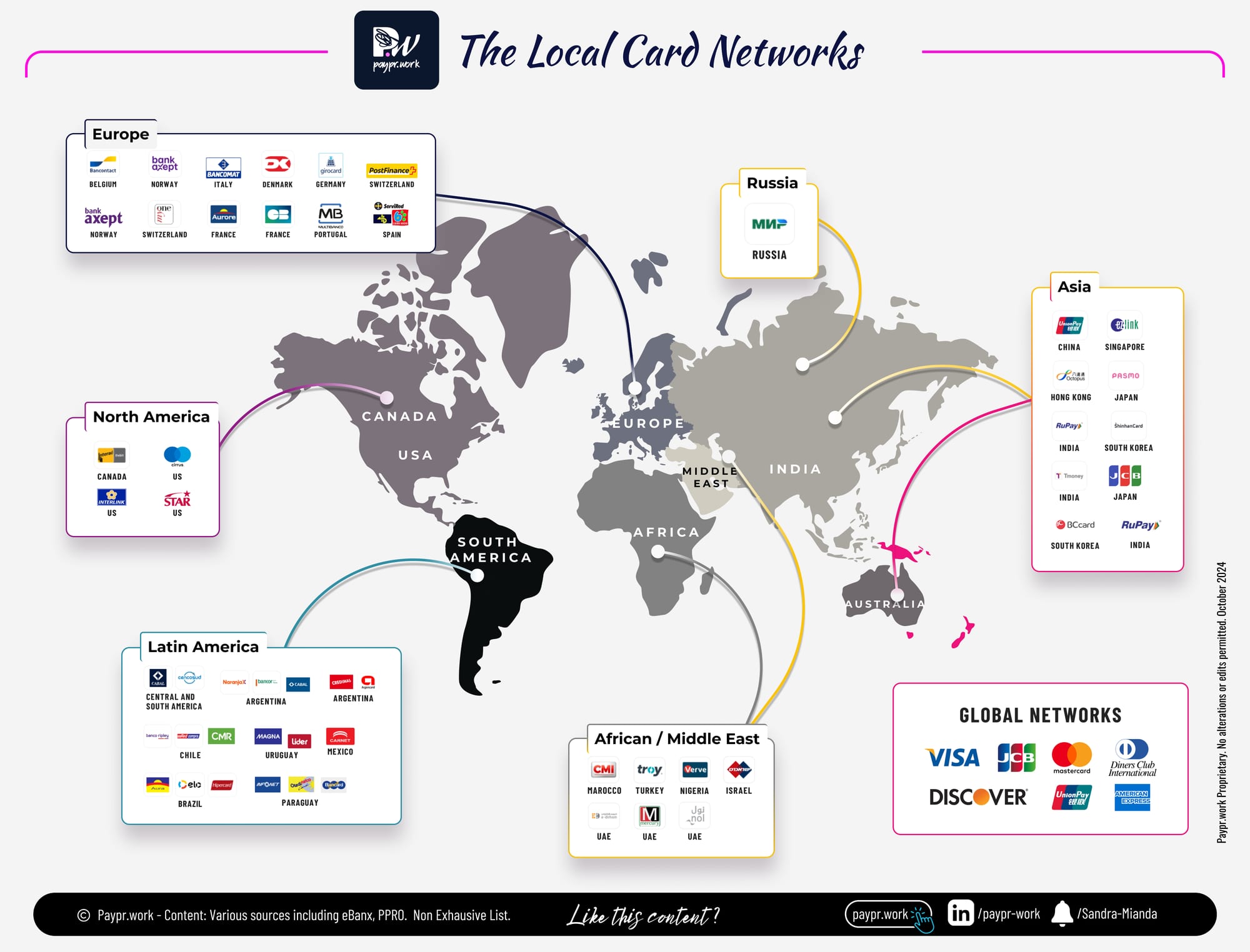
Domestic schemes by market
| Market | Region | |
|---|---|---|
| Bancontact | Belgium | Europe |
| BankAxept | Norway | Europe |
| Bancomat | Italy | Europe |
| Dankort | Denmark | Europe |
| girocard | Germany | Europe |
| PostFinance | Switzerland | Europe |
| Aurore | France | Europe |
| Cartes Bancaires (CB) | France | Europe |
| Multibanco | Portugal | Europe |
| ServiRed | Spain | Europe |
| Mir | Russia | Russia |
| UnionPay | China | Asia |
| EZ-Link | Singapore | Asia |
| Octopus | Hong Kong | Asia |
| PASMO | Japan | Asia |
| JCB | Japan | Asia |
| RuPay | India | Asia |
| ShinhanCard | South Korea | Asia |
| BCcard | South Korea | Asia |
| Interac | Canada | North America |
| Cirrus | United States | North America |
| Interlink | United States | North America |
| STAR | United States | North America |
| Cabal | Central and South America | Latin America |
| Cencosud | Argentina | Latin America |
| NaranjaX | Argentina | Latin America |
| Argencard | Argentina | Latin America |
| Banco Ripley | Chile | Latin America |
| CMR | Chile | Latin America |
| Magna | Uruguay | Latin America |
| Lider | Uruguay | Latin America |
| Carnet | Mexico | Latin America |
| Aura | Brazil | Latin America |
| Elo | Brazil | Latin America |
| Hipercard | Brazil | Latin America |
| Bancard | Paraguay | Latin America |
| CMI | Morocco | Africa / Middle East |
| Troy | Turkey | Africa / Middle East |
| Verve | Nigeria | Africa / Middle East |
| Isracard | Israel | Africa / Middle East |
| Mercury | United Arab Emirates | Africa / Middle East |
The vocabulary
- Local card network
- A card scheme that operates within one country or region, usually built by that market's own banking system. Also called a domestic scheme. Examples include girocard in Germany, Cartes Bancaires in France, Interac in Canada and RuPay in India.
- Global network
- A scheme that operates across borders and is accepted internationally: Visa, Mastercard, American Express, JCB, Diners Club International, Discover and UnionPay. These are the networks most merchants configure first, and in some markets the only ones they configure at all.
- Co-badging
- A single physical card carrying both a domestic scheme and a global one, so it works at home on the local rails and abroad on the international network. Common across Europe, and the reason a merchant may be able to route the same card two different ways.
- On-Us routing
- A transaction where the issuer and the acquirer sit within the same institution or domestic network, so the payment never leaves that infrastructure. Typically produces fewer false declines, faster settlement and lower scheme and FX fees.
What this changes for a merchant
Domestic schemes are not a completeness exercise. They change three things a merchant already measures.
- Whether the customer can pay at allIn markets with a strong domestic scheme, a share of shoppers hold a card that simply will not work on an international-only setup. That is not a conversion problem to optimise — it is a checkout the customer cannot complete.
- What the transaction costsStaying on domestic rails can avoid scheme-level processing and cross-currency charges altogether, or price them more favourably, because the risk and the cost-to-serve are both lower.
- How often it is approvedIssuers are generally more comfortable approving transactions that originate inside their own network. Fewer cross-network checks means fewer false declines on perfectly legitimate payments.
A note on this list
This map is non-exhaustive. It covers the schemes most likely to matter when planning acceptance in a new market, not every card network in existence, and coverage shifts as domestic schemes merge, rebrand or are absorbed.
Content is drawn from various sources including EBANX and PPRO.
Treat it as a starting point for a market-entry conversation rather than a settled reference: before launching in a market, confirm the current domestic scheme and whether your acquirer actually supports it.
Frequently asked questions
- What is a local card network?
- A local card network — also called a domestic scheme — is a card system that operates within a single country or region, usually built by that market's own banking system rather than by an international network. girocard in Germany, Bancontact in Belgium, Interac in Canada and RuPay in India are all examples.
- Why do local card networks matter for merchants?
- They affect three things at once: whether a customer can pay at all, since some shoppers hold only a domestic card; what the transaction costs, because staying on local rails can avoid scheme and cross-currency fees; and how often the payment is approved, because issuers tend to approve transactions from inside their own network more readily.
- Which countries have their own domestic card scheme?
- Most large markets do. In Europe: Belgium (Bancontact), Germany (girocard), France (Cartes Bancaires), Italy (Bancomat), Denmark (Dankort), Norway (BankAxept), Portugal (Multibanco), Spain (ServiRed) and Switzerland (PostFinance). Elsewhere: Canada (Interac), Russia (Mir), China (UnionPay), India (RuPay), Japan (JCB), South Korea (BCcard, ShinhanCard), Brazil (Elo, Hipercard), Mexico (Carnet), Turkey (Troy), Nigeria (Verve) and Morocco (CMI), among others.
- What is the difference between a local and a global card network?
- A global network — Visa, Mastercard, American Express, JCB, Diners Club International, Discover or UnionPay — is accepted across borders. A local network operates within one country or region and generally does not work abroad. Many cards are co-badged, carrying both, so the same card runs on domestic rails at home and international rails elsewhere.
- Do I need a local acquirer to accept a domestic card scheme?
- Often, yes. Domestic schemes are typically reached through acquirers licensed in that market, which is one of the main arguments for a multi-acquirer setup when entering new geographies. It is also what makes On-Us routing possible, where issuer and acquirer sit in the same domestic network and the transaction never leaves it.
Take it with you
You have just read the whole thing — this is the same content as a file you can keep and share. Infographic · 1 page